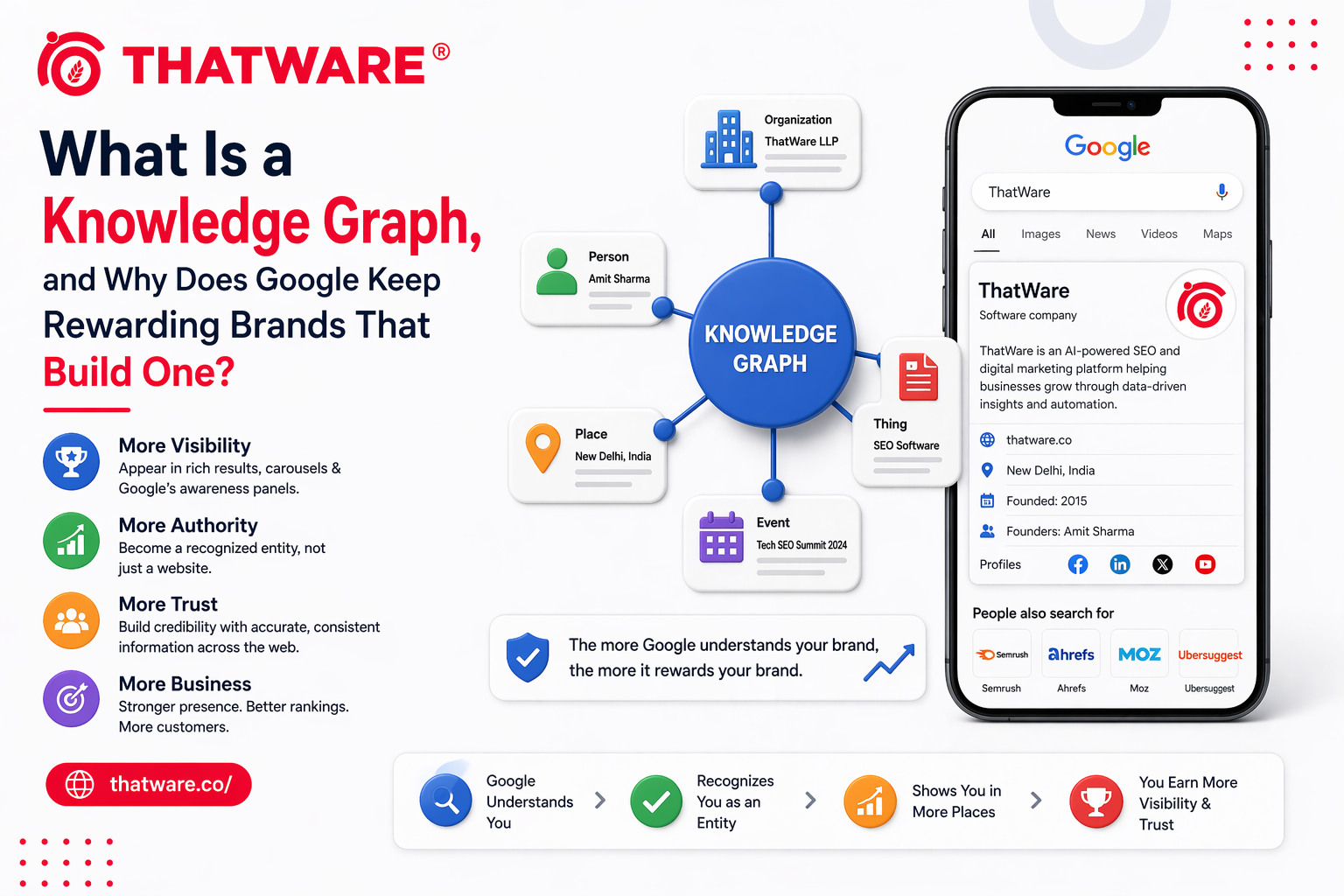
The Knowledge Graph doesn’t announce itself. You’ve been interacting with it for years without necessarily thinking about what it is. When you search for a company and a box of organized information appears on the right side of the results page, that’s the Knowledge Graph. When Google confidently tells you a CEO’s name, a company’s founding date, or a brand’s product categories without you clicking anywhere, that information is coming from the Knowledge Graph.
It’s Google’s structured database of entities and the relationships between them. Not a list of pages. A map of things, real-world concepts, organizations, people, products, places, and how they connect to each other.
Understanding this is important because Google’s ranking systems increasingly use the Knowledge Graph to evaluate whether a brand is a real, trustworthy entity rather than just a collection of keyword-optimized pages. And the brands that have intentionally built their knowledge graph presence are getting rewarded in ways that are measurable and meaningful.
Related readingThe Quiet Tug of War: Edge AI vs Cloud AI in a Changing Tech Landscape
Entities vs. Keywords: A Different Way of Thinking
Traditional SEO is built around keywords. You identify terms people search for, you create content targeting those terms, you build authority signals that tell Google your content is worth ranking for those terms.
The Knowledge Graph operates on entities, not keywords. An entity is a distinct thing that exists in the world: a company, a product, a person, a concept. Google identifies entities and builds relationships between them. “Company X sells product Y in market Z and was founded by person A” is entity knowledge, not keyword matching.
When Google can confidently identify your brand as a recognized entity with clear, verified attributes, your content gets treated differently than content from an unrecognized source. Entity recognition confers a kind of baseline credibility that affects how your pages are evaluated, how your brand appears in knowledge panels and AI-generated summaries, and how confidently Google surfaces your information in response to relevant queries.
Related readingA Mirror That Thinks: How Digital Twins Are Quietly Changing the Real World
Building this entity presence is a different task from keyword optimization, and it requires a different approach.
How Knowledge Graph Presence Gets Built
The Knowledge Graph is populated from many sources. Wikipedia is influential but not the only one. Wikidata, schema markup on websites, structured data in business directories, mentions in authoritative publications, Google’s own crawling and entity extraction. These sources get cross-referenced to build a confident model of what an entity is and what can be reliably said about it.
For brands trying to build Knowledge Graph presence intentionally, a few things matter.
Consistency is primary. The same information about your brand, name, founding details, product categories, leadership, location, should appear consistently across every source where it’s mentioned. Inconsistencies create confusion in the entity model and weaken confidence.
Related readingThe Day Passwords Stop Being Your Biggest Headache
Authoritative sourcing matters. Being mentioned and described on sources that Google considers authoritative, major publications, industry databases, regulatory filings, established directories, carries more weight than mentions on low-authority sites.
Structured data on your own site is part of the picture. Organization schema, product schema, person schema for leadership, and other relevant markup types help Google extract structured information directly from your site to inform its entity model.
Knowledge graph seo services that understand this landscape build across all these layers rather than treating schema markup as the entire solution.
Why This Matters More Now Than Before
The shift toward AI-generated search responses has made Knowledge Graph presence more consequential, not less. When a language model is synthesizing an answer about a topic and deciding which brands to mention, which products to recommend, which sources to draw on, it’s working from its internal model of which entities are credible and relevant.
That model is substantially informed by structured entity knowledge, including Knowledge Graph data. A brand with a strong, consistent entity presence across the web is more likely to be surfaced in these synthesized responses than a brand that’s primarily optimized for keyword rankings without attention to entity-level representation.
The strategic implication is that knowledge graph building is not a side project for SEO nerds. It’s increasingly a core component of how brands get found in the search landscape that’s rapidly becoming the dominant one.
Semantic SEO and the Content Dimension
Knowledge Graph presence and semantic SEO are closely related but distinct. Semantic SEO refers to building content that Google can understand in terms of meaning and context, not just keyword matching.
This means building topical coverage that establishes genuine depth in a subject area, using structured markup that makes content meaning explicit, and creating the kind of interconnected content architecture that demonstrates comprehensive knowledge of a topic area rather than isolated keyword targeting.
A semantic seo services approach treats content not as a collection of individual pages targeting individual keywords but as a structured knowledge base that establishes your brand’s authority over a conceptual territory.
The effect of this, when done well, is that Google’s confidence in your brand as a credible source across a topic area increases. New pages you publish start from a stronger authority baseline. Your content gets evaluated more favorably in relation to user queries that you haven’t specifically optimized for, because the system understands what you’re about at a conceptual level.
Practical Starting Points
If you’re thinking about where to start with knowledge graph and semantic SEO work, a few priorities tend to produce the most meaningful early progress.
Audit your existing entity data for consistency. Check how your brand appears across directories, Wikipedia if you have an entry, your own website, and major publications. Identify and correct inconsistencies.
Implement comprehensive schema markup on your site. Organization, products, services, people, articles. This doesn’t need to be done all at once, but systematic schema implementation across your most important pages is high-value work.
Build authoritative external mentions. Think about which publications and databases your industry cares about and develop a presence in those sources.
The long game in SEO increasingly favors brands that Google understands and trusts at the entity level. Building that trust is foundational work that compounds over time.