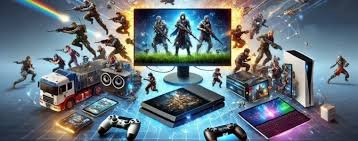
There was a time when gaming felt… divided. PC players stayed in their lane, console players had their own ecosystem, and mobile gamers were often treated like a completely separate crowd. If your friends were on a different platform, tough luck—you either switched devices or missed out.
But that wall? It’s slowly crumbling.
Today, it’s not unusual to see someone playing on a phone teaming up with a friend on a console, while another joins in from a laptop. It feels more natural, almost like gaming is finally catching up to how people actually live—connected, flexible, a little chaotic.
The Rise of “Play Anywhere” Culture
At its core, cross-platform gaming is simple: play the same game across different devices, together. But the impact is bigger than it sounds.
Related readingThe Future of Gaming Might Be a Room You Walk Into
In India, where device diversity is huge, this matters a lot. Not everyone owns a gaming console or a high-end PC. Many players rely on smartphones, often mid-range ones. Cross-platform support bridges that gap, making multiplayer experiences more inclusive.
You don’t need the same hardware anymore—just the same game and a decent internet connection.
Mobile Is Leading the Charge
Let’s be honest—mobile gaming dominates India. Affordable smartphones and cheap data have turned millions into gamers, even if they don’t identify as one.
Related readingBuilding Games from Scratch: The Quiet Rise of Indie Developers in India
So when games introduce cross-platform play, mobile users suddenly become part of a much larger ecosystem. They’re not just playing among themselves anymore—they’re stepping into a shared space with console and PC players.
That’s exciting, but it also brings challenges. Balancing gameplay between touch controls and traditional controllers isn’t always easy. Developers have to work harder to keep things fair.
The Competitive Edge (and Its Complications)
Cross-platform gaming opens doors for bigger player bases and faster matchmaking. That’s great for casual gaming, but in competitive scenarios, things get tricky.
A PC player with a mouse and keyboard might have an advantage over someone using a touchscreen. Even console players with controllers sit somewhere in between.
Some games solve this by offering input-based matchmaking, while others let players opt out of cross-platform play entirely. It’s not perfect, but it’s evolving.
And this evolution is exactly why people are starting to ask: Cross-platform gaming ka future India me kya hai?
Internet Infrastructure Still Plays a Role
India’s internet landscape has improved dramatically, but it’s not uniform.
In metro cities, high-speed connections make seamless cross-platform gaming possible. But in smaller towns or rural areas, inconsistent connectivity can still be a barrier.
Latency issues, lag, and sudden disconnects can affect the experience, especially in multiplayer games. For cross-platform gaming to truly thrive, stable internet access needs to reach deeper across the country.
The Social Side of Gaming
Here’s something that often gets overlooked—gaming isn’t just about gameplay anymore. It’s social.
Friends connect, chat, compete, and unwind together. Cross-platform gaming strengthens this social layer by removing device-based barriers.
You don’t have to convince your friend to buy the same console or upgrade their PC. If the game supports cross-play, you’re good to go.
In a country like India, where gaming communities are still growing, this kind of accessibility can make a big difference.
Developers Are Adapting—Slowly but Surely
More and more game developers are embracing cross-platform compatibility, but it’s not always straightforward.
There are technical challenges, licensing issues between platforms, and the need to maintain consistent performance across devices with vastly different capabilities.
Still, the direction is clear. The demand is there, and developers are responding. Not every game supports cross-play yet, but the list is growing.
The Business Angle
From a business perspective, cross-platform gaming makes a lot of sense.
It expands the player base, increases engagement, and keeps games relevant for longer periods. Players are more likely to stick with a game if they can access it from multiple devices and play with a wider group of friends.
For Indian gamers, this could mean better access to global titles and more opportunities to participate in larger gaming communities.
A Future That Feels More Connected
If you step back and look at the bigger picture, cross-platform gaming is less about technology and more about connection.
It’s about removing friction. About making gaming less exclusive and more inclusive. About letting people play together, regardless of what device they own.
And in India, where diversity in devices and access is the norm, that matters.
A Thought to Leave You With
Gaming has always been about bringing people together—sometimes in the same room, sometimes across continents.
Cross-platform play feels like the next natural step in that journey.
It’s not perfect yet. There are challenges, limitations, and growing pains. But the direction is clear.
A future where the screen you use matters less than the experience you share.
And honestly, that sounds like a game worth playing.