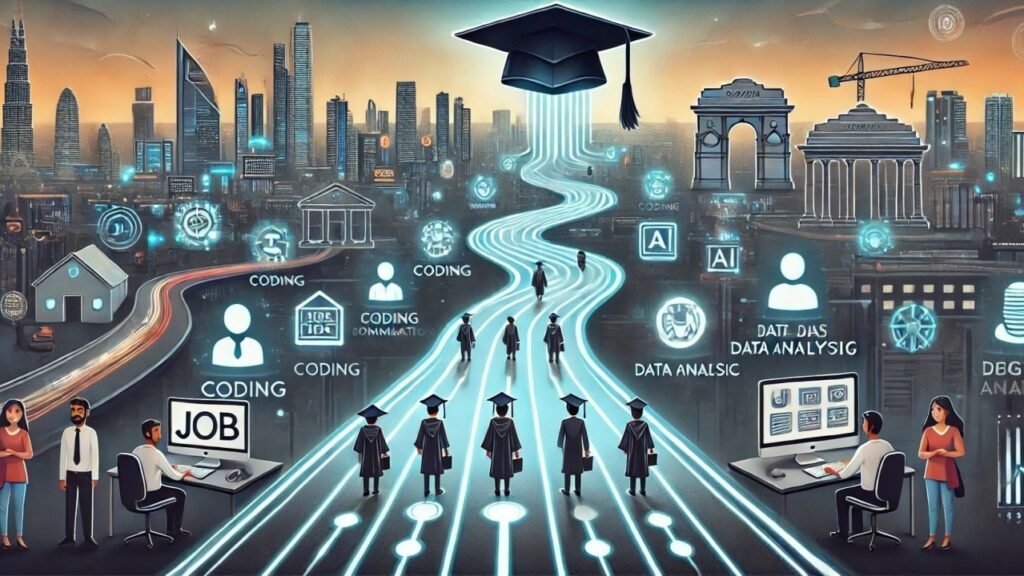
There’s a quiet shift happening in India, and you can feel it in conversations—at family dinners, college corridors, even WhatsApp groups. The old formula felt simple: study hard, get a degree, land a stable job. For decades, that path worked.
But today, things are… less predictable.
A graduate from a top college might still struggle to find a job, while someone with no formal degree is building a solid income through freelancing or digital skills. It makes you pause and wonder—what actually matters now?
The Traditional Weight of Degrees
Let’s be honest, degrees still carry weight in India. A B.Tech, MBA, or CA tag doesn’t just represent education—it signals discipline, consistency, and a certain social status.
Related readingStudying Smarter, Not Harder: How AI Is Quietly Changing Student Productivity
Parents trust it. Employers often still prefer it. In many fields like medicine, law, or government jobs, degrees aren’t optional—they’re essential.
And there’s comfort in that structure. You follow a defined path, clear exams, collect your certificate, and step into the job market. It’s familiar. Almost reassuring.
But familiarity doesn’t always mean relevance.
The Rise of Skills in a Digital Economy
Somewhere along the way, the internet quietly changed the rules.
Related readingTaking a Pause: What a Gap Year Really Means for Indian Students
Today, you can learn graphic design on YouTube, coding through online bootcamps, or digital marketing via real-world projects. No classrooms, no strict timelines. Just skill, practice, and consistency.
And the market is responding.
Companies are slowly shifting focus from “What degree do you have?” to “What can you actually do?” Especially in tech, marketing, content, and creative fields, portfolios often speak louder than certificates.
It’s not uncommon now to see a self-taught developer outperform someone with a formal degree. Not because degrees are useless—but because skills are immediate, visible, and testable.
Where the Confusion Begins
This is where it gets tricky. Students—and even working professionals—find themselves stuck between two narratives.
On one side, there’s the traditional path backed by parents, institutions, and social validation. On the other, there’s this new world of skill-based learning that promises faster results and flexibility.
Naturally, the question comes up: Skill-based learning vs degree-based learning: India me kya better hai?
And honestly, there’s no one-size-fits-all answer.
The Strengths of Skill-Based Learning
Skill-based learning has one big advantage—it’s practical.
You’re not just learning theory; you’re applying it in real-time. Building projects, solving problems, experimenting, failing, and trying again. It’s messy, but it works.
It’s also faster. Instead of spending three or four years on a degree, you could pick up a high-demand skill in months and start earning sooner.
And then there’s flexibility. You can learn at your own pace, choose your niche, and even switch paths without starting from scratch.
But—and this is important—it requires self-discipline. Without structure, it’s easy to lose direction or jump from one skill to another without mastering anything.
Where Degrees Still Matter
Despite all the buzz around skills, degrees aren’t going anywhere.
In many industries, they act as a baseline filter. A degree tells employers that you’ve gone through a certain level of academic rigor. It provides a foundation—sometimes theoretical, sometimes outdated—but still valuable.
There’s also the network. College life, internships, peer groups—these experiences shape your personality and open doors in ways online courses often can’t.
And let’s not forget the credibility factor. In a competitive job market, having a recognized degree can still give you an edge, especially in the early stages of your career.
Maybe It’s Not Either-Or
Here’s a thought that doesn’t get enough attention: what if the real answer isn’t choosing one over the other?
What if it’s about combining both?
A degree can give you structure and foundational knowledge. Skills can make you relevant and adaptable. Together, they create a stronger profile.
Think of it this way—a degree gets your foot in the door, but skills help you stay in the room.
The Reality of Today’s Job Market
Employers today are dealing with rapid change—new technologies, shifting consumer behavior, evolving industries. They need people who can learn quickly, adapt, and solve real problems.
That’s why candidates who bring both knowledge and practical skills stand out.
It’s not about how you learned—it’s about what you can do with what you learned.
A More Personal Way to Decide
If you’re a student trying to figure this out, maybe don’t start with the system. Start with yourself.
Are you someone who thrives in structured environments? A degree might suit you.
Do you prefer hands-on learning and flexibility? Skills could be your path.
Or maybe, like many people, you’re somewhere in between.
And that’s okay.
A Thought to Take With You
Education is evolving, whether we like it or not. The lines between formal and informal learning are blurring.
Degrees still matter. Skills matter more than ever. But at the end of the day, what really counts is your ability to grow, adapt, and stay curious.
Because in a world that keeps changing, the real advantage isn’t what you’ve learned—it’s how willing you are to keep learning.